Sorry for overlooking your song per se, @Lanfranco: I thought it was more a technical experiment than an actual exercise in songwriting. I will have a focused listening, and let you know my earnest thoughts.
Cheers 
Sorry for overlooking your song per se, @Lanfranco: I thought it was more a technical experiment than an actual exercise in songwriting. I will have a focused listening, and let you know my earnest thoughts.
Cheers
I checked on your track @Lanfranco.
First off, I wonder if you also provided Suno with the melody, to render the words with, or it sort-of-concocted it for itself, based on the input lyrics and your original chordal, timbral and rhythmic framework.
I have to say, anyway, that the mingling of European jazzy progressions and Arabic singing, with its trademark chromatic and microtonal inflexions and embellishments, sounds quite convincing. There are effective dynamic buildups and releases overall, in the context of a well-designed musical narrative (despite most of the text being obviously indecipherable), and this alone is a commendable compositional feature.
From the standpoint of AI vocal generation, the Italian part comes out as quite artificial in pronunciation, hardly natural and almost as delivered by a foreign speaker, which incidentally might even be plausible in this specific case (an Arabic female singing in Italian). In particular, the first statement in Italian language is almost incomprehensible.
As for the music itself,
On the upside: I deem it reminiscent of the more meditative side of Fossati (and I say It as a compliment), albeit with a character of existential desperation which distances itself from the model, adopting a legitimate tone of political critique that at places - take it as a neutral aesthetic appreciation - feels more rhetorically pathetic than authentically engaged.
On the downside: while the whole instrumental and (later on) orchestral concept is effectively laid out, the melody has to it a sort of constant improvisational character, don’t know if imparted by Suno or of your own writing, that I consider a point of weakness in terms of compositional technique. The vocal progress struggles to convey a sense of structural preparation, for the final flowering of an assertive lead theme carved in stone, which is always necessary in good songwriting. A more careful crafting of the vocal shapes, maybe with less text, would help in better conjuring the rather serious meanings of the lyrics.
The aerophone solo (sax?) is certainly you: elegant and remarkable playing.
As ever, these notes aim at relating my technically based and as objective as possible opinions, which obviously reflect my subjective cultural orientation.
Thanks for the reply @Aethermind.
I PMed you to explain in Italian how I used Suno. I created the song and added a trumpet to create the melody. Then I asked Suno to replace the trumpet with an Arabic voice singing in Arabic and Italian with an Arabic accent (Radiodervish style). Suno didn’t follow the trumpet’s melody perfectly, but I think he improved with those typical Middle Eastern warbles. The aerophone is actually a DuDuk, an Armenian double-reed flute. It has an amazing sound, in fact, both I and a saxophonist friend want to get one. As for the criticism of the melody, I agree, although making a verse and chorus consistent would have been impossible since one verse is in Italian and one in Arabic, and the same goes for the choruses, so a completely different meter. But I’ll study it for the next song. Thank you, as always, for your compliments and your always-appreciated criticism. I’ve pasted the text below as it was written in Italian.
[Strofa 1]
Cade la notte sopra i tetti spezzati,
sopra i nomi che nessuno leggerà.
Madri in silenzio, bambini svegliati,
da un cielo che non ha pietà.
La polvere entra nelle preghiere,
nelle case dove il pane non c’è più.
E il mare guarda senza poter vedere,
da Gaza fino a Beirut.
[Ritornello]
Da Gaza a Beirut,
si alza il grido e non si spegne.
Da Gaza a Beirut,
ogni lacrima è diventata nostra.
Non chiamarlo destino,
non chiamarla verità.
Quando muore un bambino,
muore tutta l’umanità.
[Strofa 2]
C’erano strade, finestre e canzoni,
c’erano voci sedute nei caffè.
Ora restano muri, sirene e illusioni,
e chi sopravvive si chiede perché.
Ma sotto le macerie nasce ancora
una voce forte.
È memoria, è ferita, è aurora,
da Gaza fino a Beirut.
[Ritornello]
Da Gaza a Beirut,
si alza il grido e non si spegne.
Da Gaza a Beirut,
ogni lacrima è diventata nostra.
Non chiamarlo destino,
non chiamarla verità.
Quando muore un bambino,
muore tutta l’umanità.
[Verse 1]
Night falls over the broken roofs,
over the names no one will read.
Mothers in silence, children awakened,
by a sky that has no mercy.
The dust enters the prayers,
in the homes where there is no bread anymore.
And the sea looks on without being able to see,
from Gaza to Beirut.
[Chorus]
From Gaza to Beirut,
the cry rises and is not silenced.
From Gaza to Beirut,
every tear has become ours.
Don’t call it destiny,
don’t call it truth.
When a child dies,
all humanity dies.
[Verse 2]
There were streets, windows, and songs,
there were voices sitting in cafes.
Now all that remains are walls, sirens, and illusions,
and those who survive wonder why.
But beneath the rubble,
a strong voice is still born.
It is memory, it is wound, it is dawn,
from Gaza to Beirut.
[Chorus]
From Gaza to Beirut,
the cry rises and does not die.
From Gaza to Beirut,
every tear has become ours.
Don’t call it destiny,
don’t call it truth.
When a child dies,
all humanity dies.
Hi Lanfranco,
very well done. I can understand your problem with finding a native singer for the vocals. Did you try to combine the Voices of Sahara with a Vocoder? This way you could maybe use your own voice? With AI voices I do always notice a very strange chorus effect. I can’t really explain it, but I do notice the AI voice instantly. But this might be a SUNO thing. I used your italian lyrics right away as a “lesson” for my italian
Best,
Anzound
Thanks, but using the vocoder with Voci del Sahara I don’t think you can create words… and then how could I sing in Arabic? I don’t even know English… unfortunately. Lately (but always, actually) I love the sound of the Arabic language and I think only an Arabic voice can sing this language. I don’t understand if you used the Arabic-to-Italian translation to understand my language… Do you speak Arabic? Bye
Yes, you can use words using a Vocoder. But you are right. Pronunciation is another thing. Maybe it’s also possible to use Plogues Alter Ego Synth in combination with voices of Sahara and a vocoder to make it more real? Just an idea: Alter/Ego The question remains if Alter/Ego is able to pronunciate the arabic language properly.
What DAW did you use to create this song?
No, I don’t speak arabic but I do learn italian and I did use the italian lyrics from your YT-Video 
I only speak Italian and I think it’s the most beautiful language in the world, obviously. I’m too old to try learning another language. I have the Arturia Vocoder, which I’ve never tried… do you think it might work? Thanks.
I agree. Italian is the most beautiful language in the world 
I don’t know about the Arturia vocoder. Which DAW are you using? The TAl vocoder is included in Zynthian OS as far as I know and you can also use it with different DAWs. You find a good introduction here: https://youtu.be/o9cLdUtWk2A
I use Fender Studio Pro. I’ll study it. Thanks for the link. Bye.
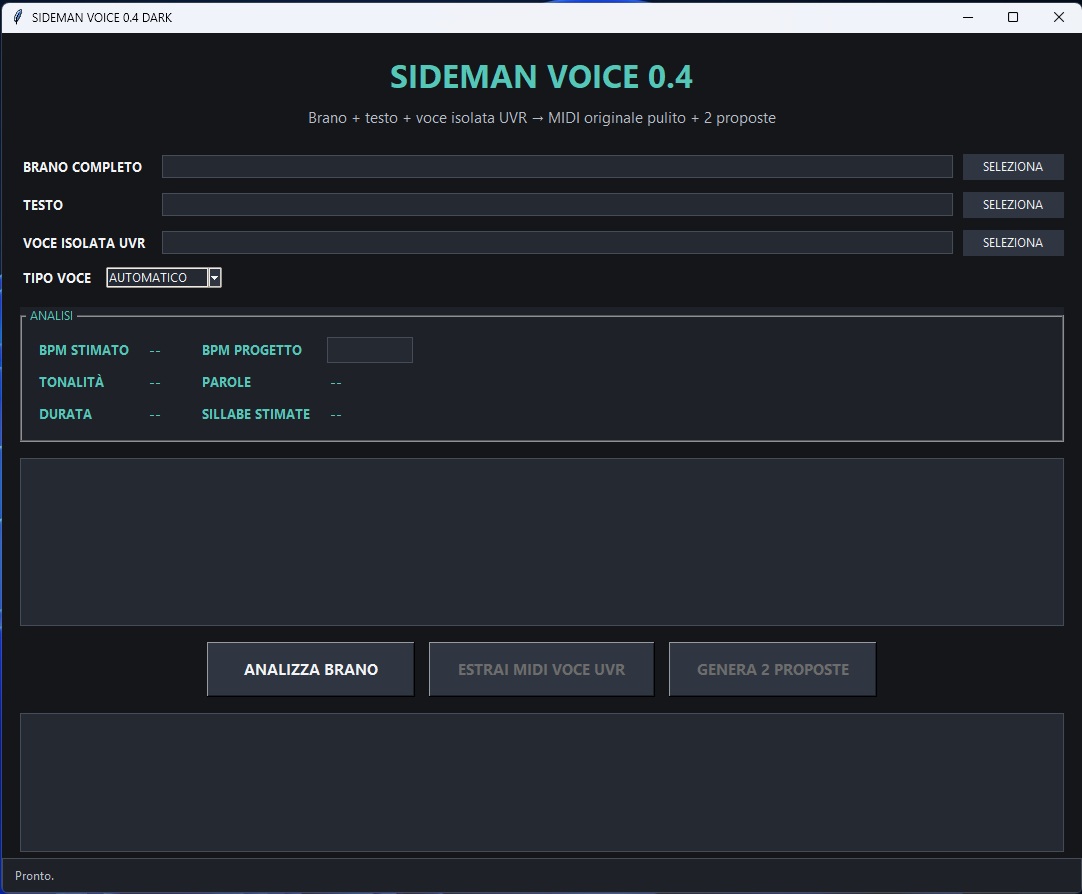
With the help of ChatGpt I am creating a software where you insert a piece of music and a melodic line is proposed ONLY for the voice, a midi file is exported that can be modified with a VST and then once fed a .wav file will be created with the voice of your choice… anyone want to collaborate?
I’m making it for Windows (though I use Mac for music) but I don’t think there will be any problems putting it on Zynthian if it’s interesting to enough users…
Obviously Open Source.