Thanks Wapata and Riban
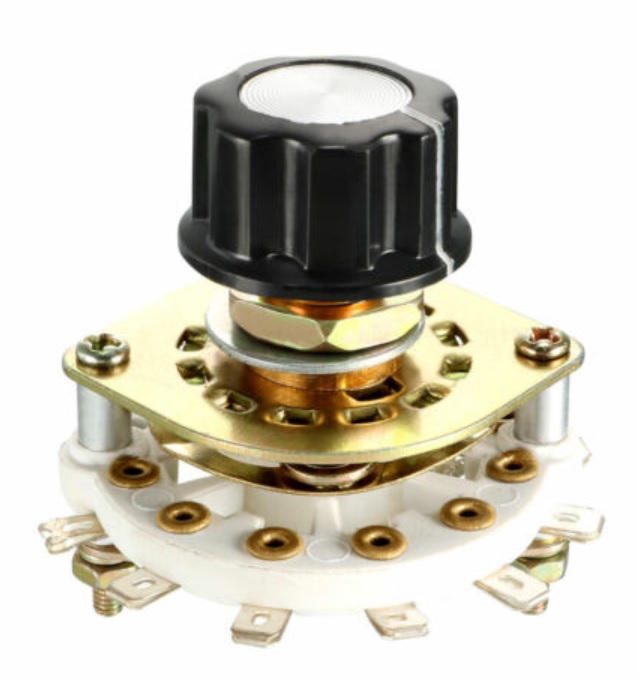
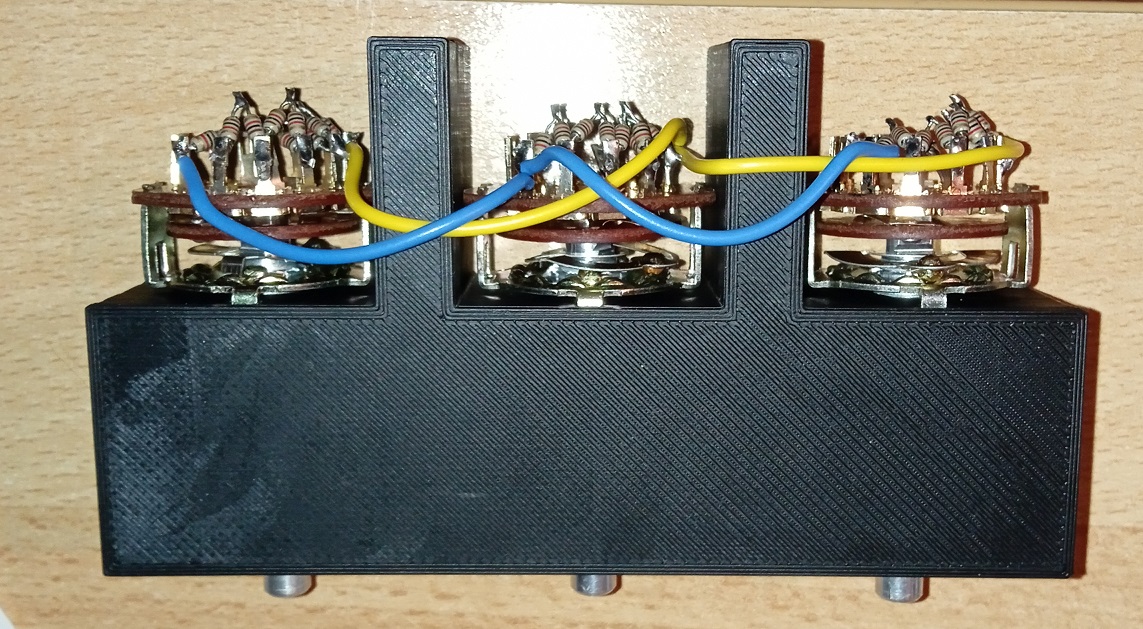
I’ve already done the tester test, before asking for help. In practice from terminal A you switch 1,2,3 and 4… 5,6,7 and 8 from pin B… 9,10,11 and 12 from pin C… the problem is that when you goes to position B 5, A 1 also goes into closed circuit… I have to look for another switch…
The 3 pole 4 position switch is probably designed for that configuration and not to have its end-stops removed. If that is the case I would expect that positions 1-4 would give the same results as positions 5-8, i.e. position 1 and position 5 would have A1, B5 & C9 closed. If this is true then you can’t really use this switch as there is no difference between positions 1 & 5. If however there is a different presentation of closed / open circuit when in each position then it may be possible to use the switch for this purpose.
What you really need is the same type of switch but with one pole and twelve positions. These allow the end-stop to be adjusted to create a one pole ‘n’ position switch where ‘n’ is 1-12 which is what you want. You could use such a switch for each of the panel switches.
This datasheet describes one switch type with lots of configurations. The model I would choose is CK1029 or similar.
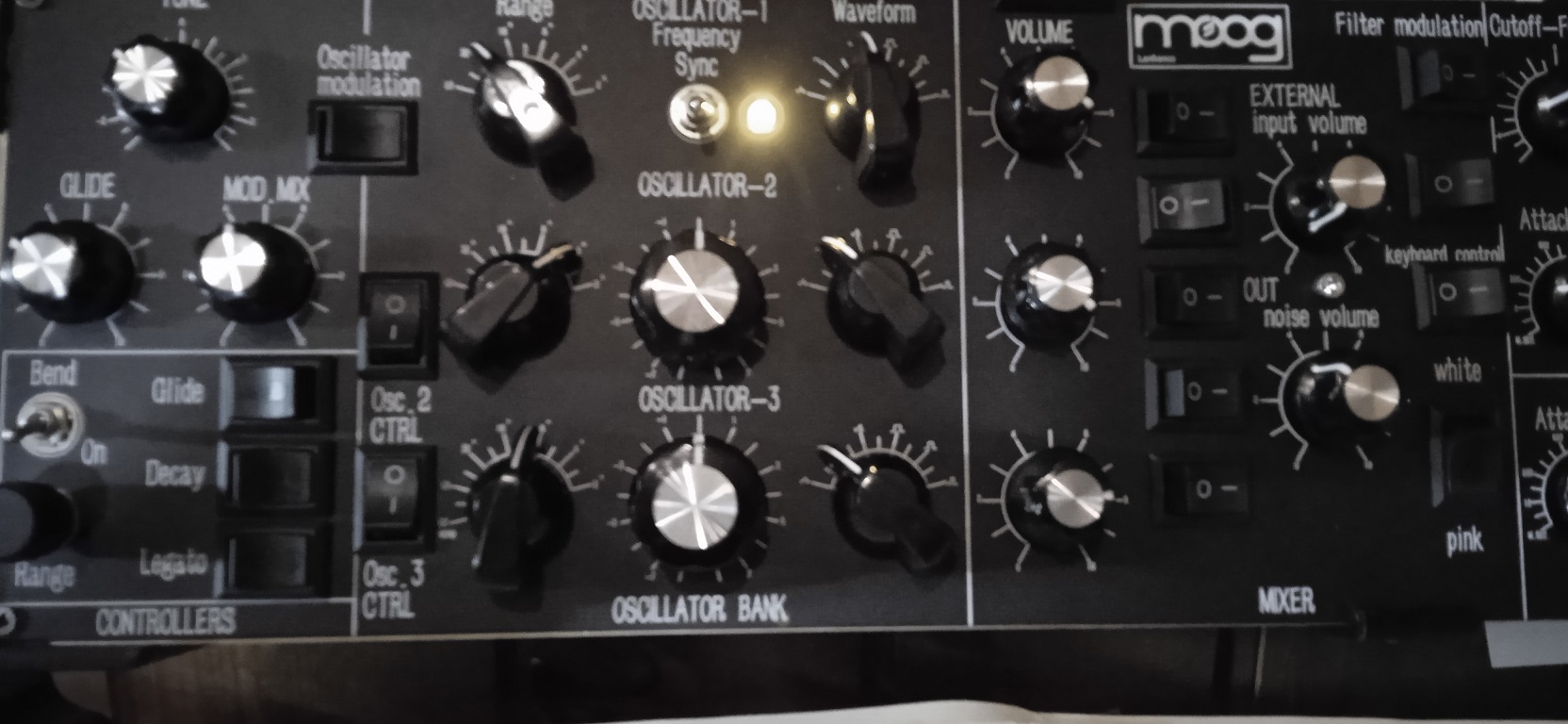
Thank you Riban… in the meantime I’ve mounted the five 6-position switches and I’m VERY happy because, in addition to working perfectly, the sign on the knob corresponds to the serigraphs on the front… I was afraid of the differences.
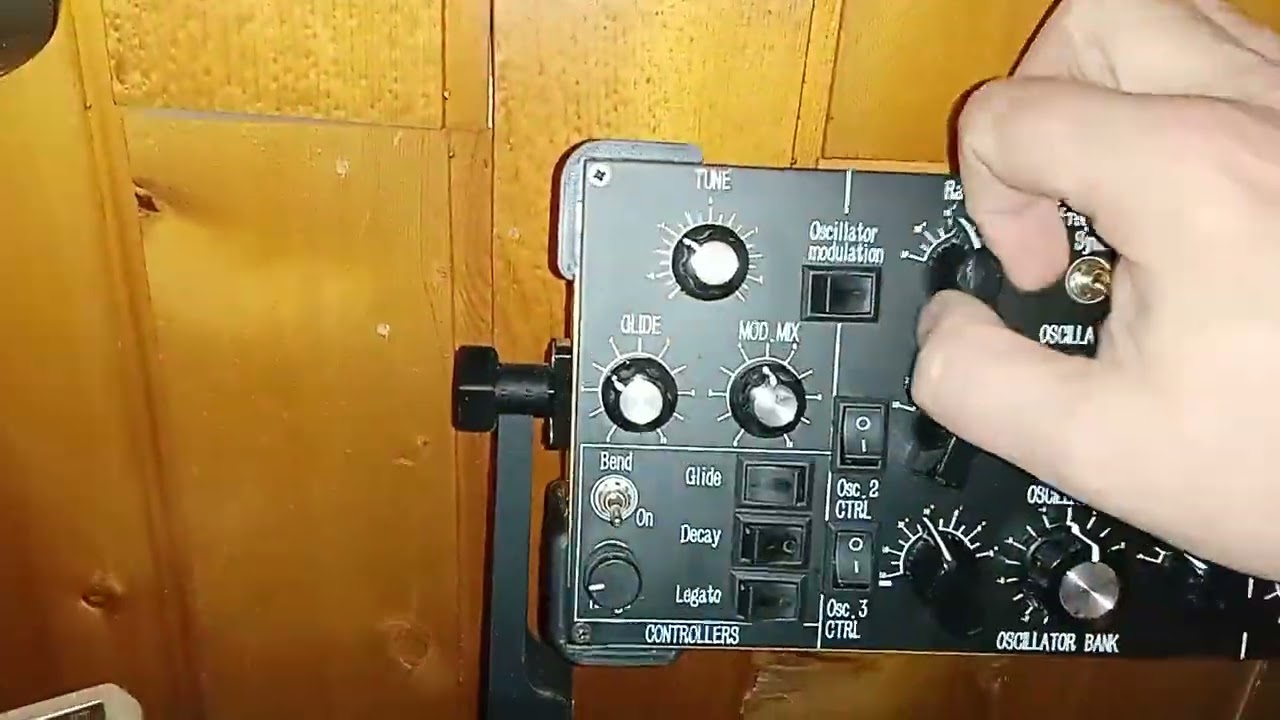
I used the display of a dead pc to have the double display of the MacBook in front of my eyes…
The collars hanging on the wall are those due to the disproportionate growth of my FRIEND Tesla
You know what ? I come back to your topic some times and… You’ve done a wonderful device here !
…
And now for the embarrassing question : do the screen help to something?
Thank you Wapata,
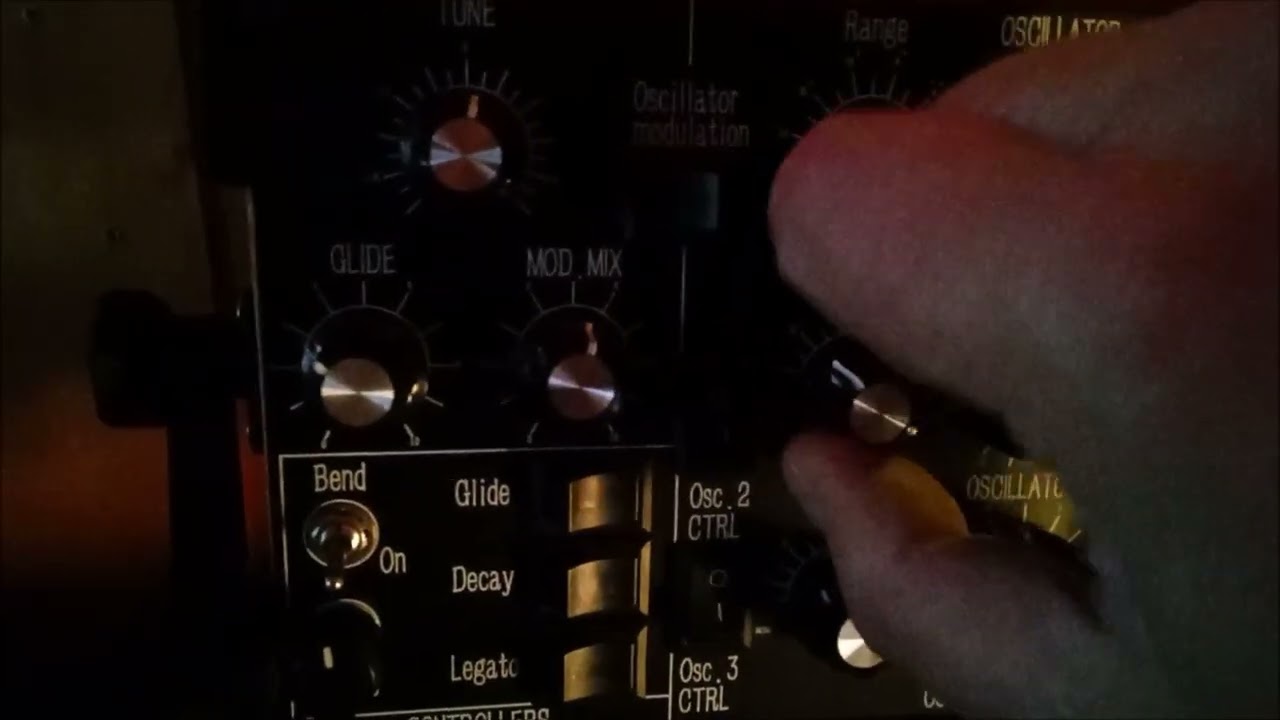
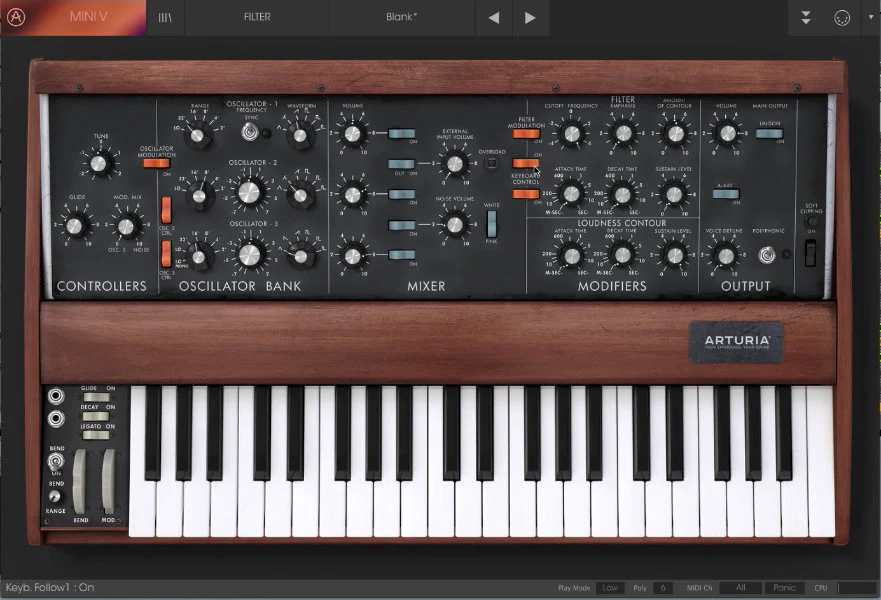
The display only serves to have Arturia’s MiniMoog in front of my eyes … nothing in particular, just a convenience when I use the laptop (white MacBook) with the MixBus DAW. In the recording room I’m used to having the iMac monitor side by side with another monitor and seeing everything without overlapping windows… and then I like to recycle and not throw away useful objects.
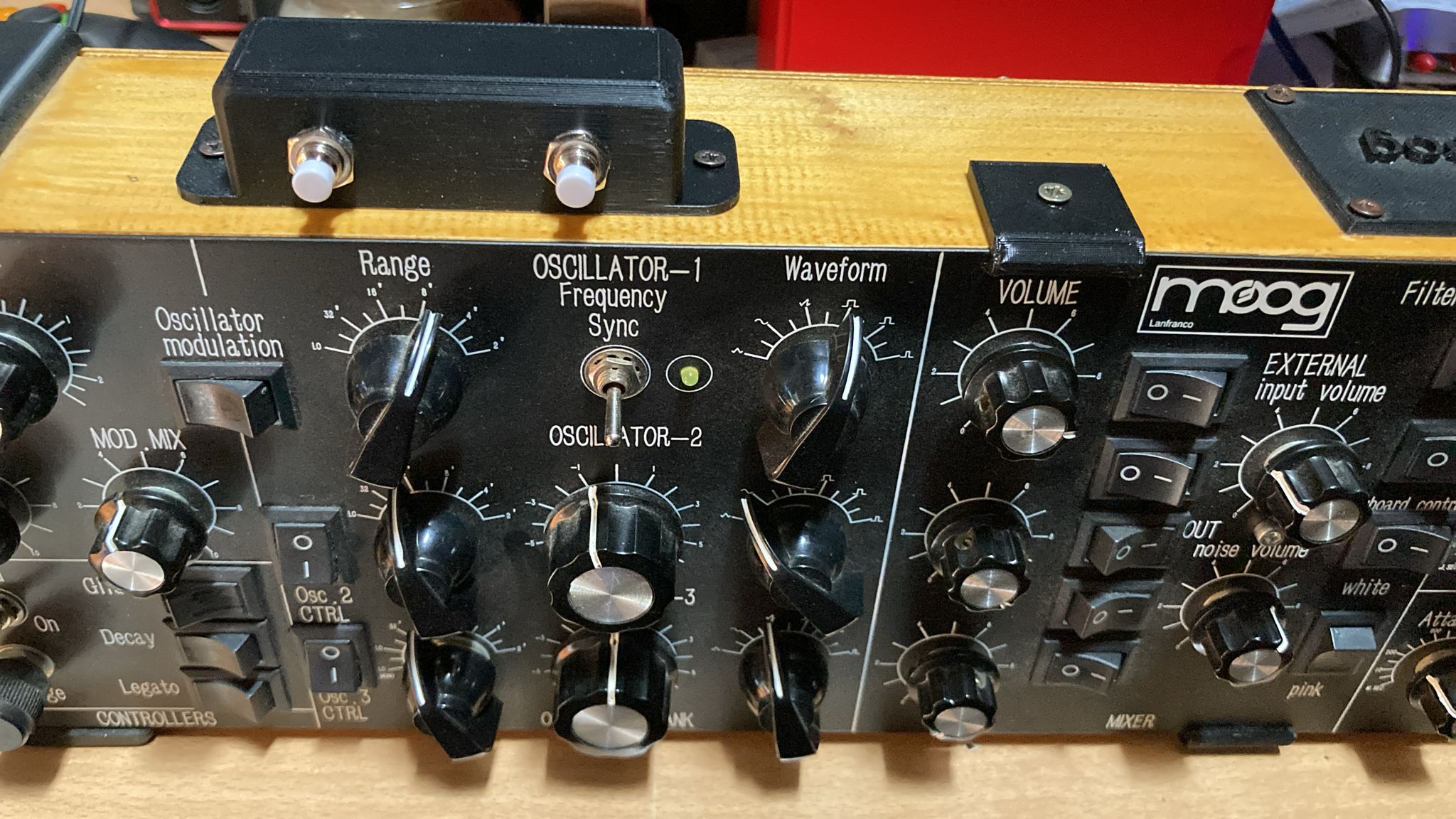
After using my controller for a long time, I decided to add two buttons to change sounds directly from the controller. So when I have a bank with all my sounds, I can navigate through them without using a mouse. Very convenient.
I don’t remember by now, along the gradual advancement of your project, if the Arturia MiniMoog emulator runs at this point on a regular desktop computer, or on a Raspberry with Windows installed.
Whatever, I wonder if you ever considered to execute the synth simulation software headless, with an autoexec batch script that loads your custom bank at the computer boot, maybe starting the program on the default patch with reset parameters, for an even more authentic 1970s experience of analog sound design!
Hi @Aethermind, I tried this with Windows installed on Raspberry Pi, but it didn’t work very well. For now, the controller is simply connected to the Mac Mini M4. But as soon as I can, I’d like to buy a small mini PC and install it inside the controller with a display… but right now they’re still too expensive. I already have a nice '7 display ready, but I don’t feel like spending money on a mini PC.
I’m waiting for someone to make a board like the raspberry but with a windows processor.. I have a GMKTec NucBox G5, but for just one device it seems like a waste to me.
Yesterday I spent almost two hours having fun modifying sounds with my controller… it’s a lot of fun…
@Lanfranco, I am on trip at the moment, but I will gladly have a look at it later.
There are several routes for using VSTs on Linux, either on regular desktop distros (Ubuntu, Debian etc.) or on Raspberry OS. I attempted out of curiosity to install Zynaddsubfx on Reaper some time ago, in a Raspberry OS environment with a Pi5 8 GB. I found the performance to be rather mediocre, with substantial latency even on quality audio interfaces, thus I dropped the whole concept straight away. As you know, VST on Zynthian is not an option at present, and I deem it quite unlikely even in the foreseeable future. So, your best bet at the moment would be to get yourself a well-performing Mini PC.
We don’t currently support VST. I am looking at an alternative option for plugin hosting which does support VST 2&3 but that is only part of the problem. Many (most?) VST are not available for aarch64 Linux so when if we could host VST, you would probably struggle to find one that runs natively on this platform.
Thanks @Aethermind and @riban, I know it’s not possible and Ms. Arturia doesn’t want to create her sounds in other formats… So I’ll wait… who knows, maybe one morning someone will create a card like Raspberry that supports Windows or Ms. Arturia will do her job…
It is more expensive than the Raspberry 5, but would allow you to run natively Linux Desktop and Windows 10/11, and with it your x86 VSTs of choice, both within a DAW and as standalone apps.
Judging from scattered telltale signs in the advertising format and site structure, I would not expect any reliable and enduring support, but the thing itself seems sound enough to give it a try.
Definitely yes. I don’t think a lot of processing power is needed for a single VST, but for the use I’d make of it—a single VST—it seems like a waste. If only Arturia would create its instruments to be used with Raspberry Pi, I’d be very happy. I have to consider that I no longer play live, so I wouldn’t use this instrument of mine much… but the idea of it being a standalone instrument drives me crazy. Yesterday I played with its sounds for another two hours, and I have to say that there’s no Moog on Arturia’s level.
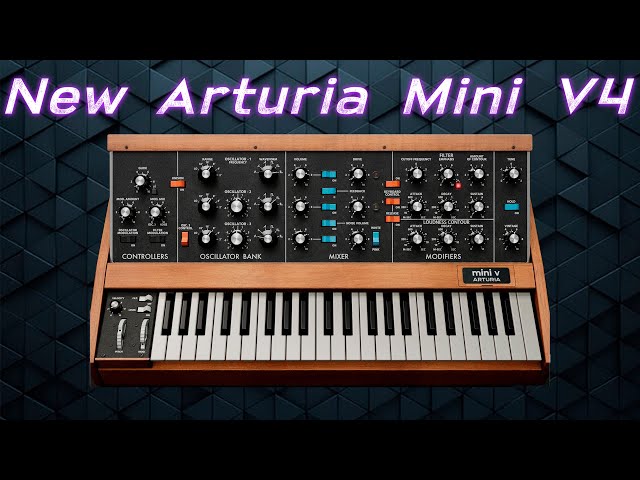
Besides, I’m still using the V3 because the V4 changed the panel layout… but comparing them I don’t hear any difference.