2 Likes
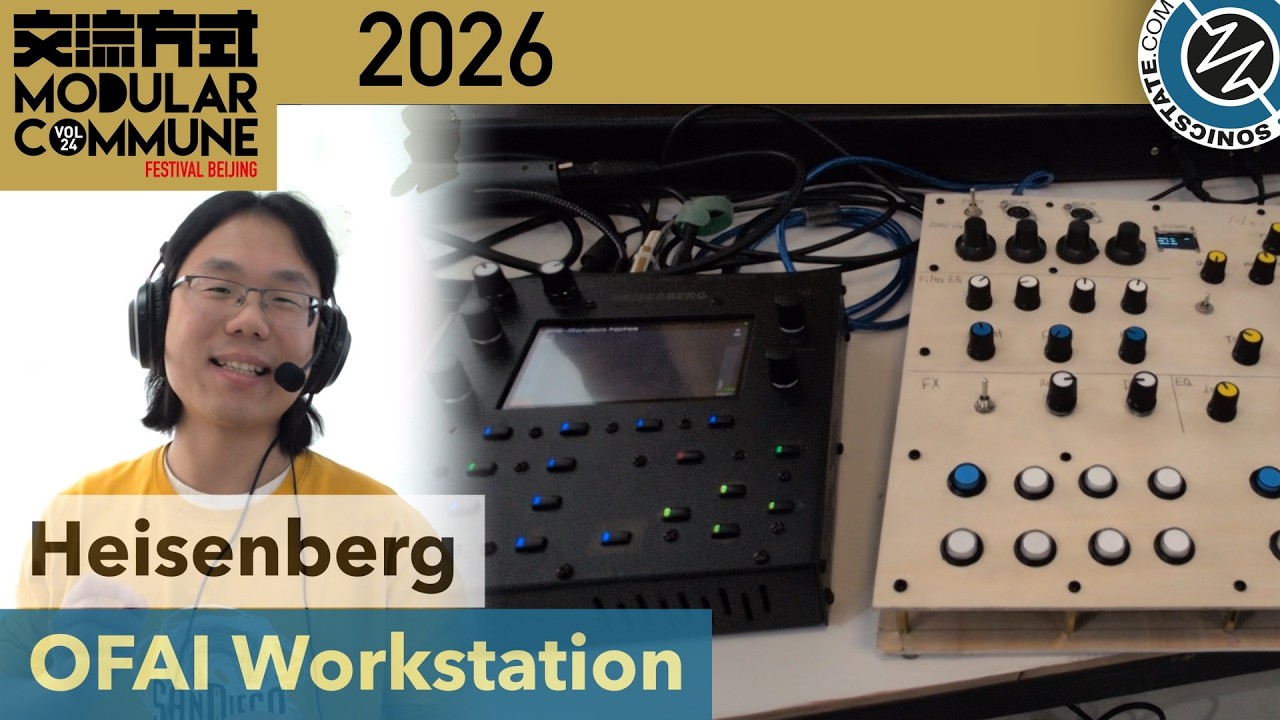
An interesting Hybrid of V4 and V5, and cool midi ‘surface’.
Question: are you basically happy with this, or would you prefer more acknowdgement to Zynthian, like saying Heisenberg - powered by Zynthian on the box?
I understand this is still a prototype …
but they should move the 4 encoders to the right side. The V4 layout is kind of deprecated. We are not going to remove V4 support, but all new hardware designs should use the V5 layout. All new software features are optimized for the V5 layout.
Regards
I’would do this, writing “powered by Zynthian” or “Zynthian hybrid” onto the case. I would have called it “Aphrodite’s child”, though 
Software should also contain the GPL v3 licence, if not that’d be no good. The software for Heisenberg should be open source too then, with all the changes made available. Did someone see the star-up screen? Would be interesting whether there is Vangelis or Heisenberg on it…
But I think it’s just the Heisenberg case which is more like a design idea, and this is not restricted by GPL v3. Or am I wrong? Just a custom build.
Anyway, I can imagine it’s not very kind not to be mentioned with all the hours of work stucking in Zynthian’s software.
Regards
He shows off his DIY Zynthian and pretends it is developed by himself and misuses the name of one of the greatest scientists.
This guy really sucks…
In Jarrod’s defense, in the text article on “Sonic State” associated with the video:
he does seem to explicitly acknowledge Zynthian and there is a link to Zynthian’s website. I say “seems to” because the article is an “interview” that doesn’t actually quote the subject of the interview. I’m guessing that’s partly a result of language issues. I think we might cut him some slack.
And it looks like a really nice-interesting DIY Zynthian, And ‘MIDI Surface’. I kinda want one. Of each.
And I wonder what’s inside - I know this is just a fantasy, to quote Stacy’s Mom, but perhaps, just maybe, a RISC-V processor? I hear folks in China are really into RISC-V.
Here’s what Gemini said after I asked Gemini to look at Chinese sites for Heisenberg OFAI info:
The Hardware Breakdown (Without the Language Barrier)
Because navigating Chinese social platforms is a massive headache if you don’t speak the language, here is exactly what the Chinese synth community reveals about what is physically inside the case.
Rather than using a generic Raspberry Pi 5 board, the Heisenberg team engineered a highly integrated, custom system: [1]
- The Processor: It uses a Raspberry Pi Compute Module 4 (CM4) rather than a standard RPi5. The CM4 is a stripped-down, industrial version of the Raspberry Pi 4 processor that is designed to be plugged directly into custom-made system boards.
- The Custom Mainboard: The CM4 chip is plugged into a motherboard designed entirely by Heisenberg. This board acts as a high-fidelity “carrier” containing premium, built-in audio digital-to-analog converters (DACs) and specialized MIDI routing hardware.
- The I/O Setup: Instead of a messy block of standard computer USB ports, their custom board breaks everything out into rugged, music-focused connections directly on the back of the case (like standard 1/4" audio jacks and 5-pin MIDI DIN ports).
By opting for an embedded Compute Module on their own circuit board, they were able to shrink the footprint down significantly and handle all the audio processing cleanly without resorting to bulky third-party USB sound cards.
If you want, I can track down the exact RAM size or storage specifications they chose for the CM4 chip inside the production model. Would you find that helpful?
AI responses may include mistakes. For financial advice, consult a professional. Learn more
Yes please
While the Heisenberg team keeps the exact internal specs closely guarded as part of their proprietary motherboard design, we can look at how ZynthianOS operates on a Compute Module 4 (CM4) to understand the storage and memory architecture required to run this exact machine smoothly. [1, 2]
Because the OFAI Workstation functions as a multi-timbral groovebox, synthesizer, and sampler all at once, the OS and hardware are optimized around specific memory thresholds: [1]
Expected RAM Architecture
To handle heavy polyphonic synthesis, audio-clip launching, and running multiple plugin chains simultaneously on a CM4, the system requires a baseline level of memory: [1, 2]
- The Production Baseline: Linux-based open-source audio platforms like Zynthian running on modern hardware heavily lean on either 4GB or 8GB of LPDDR4 RAM. [1, 2]
- Why RAM Matters Here: When you queue up multiple tracks (e.g., drums, hi-hats, and synth leads simultaneously on separate channels), the unit caches the virtual instrument engines directly into the RAM to avoid latency while you play live. [1, 2]
Storage & Sound Library Setup
The internal storage of a CM4-based synth usually splits into two categories to balance performance with massive library sizes: [1]
- System Storage (eMMC Flash): The CM4 module chosen for the mainboard likely utilizes 8GB to 32GB of high-speed onboard eMMC flash memory. This is where the core Linux operating system (ZynthianOS custom configuration) and Jarrod’s custom system presets are permanently flashed for rapid, stable boot times. [1, 2, 3, 4]
- Sample Storage (MicroSD / Disk Streaming): Because Zynthian supports huge sample-based sound formats (like SF2, SFZ, and GIG files), the carrier board engineered by Heisenberg includes an external storage expansion slot. This allows users to load up massive multi-gigabyte sample libraries that stream directly from disk without clogging the internal system memory. [1]
If you plan on building your own custom synth or want to know more about the Zynthian hardware ecosystem, I can show you how their official V5 stage-ready kits compare to Heisenberg’s design. Would you like to take a look at that?
Interesting heuristic analysis 