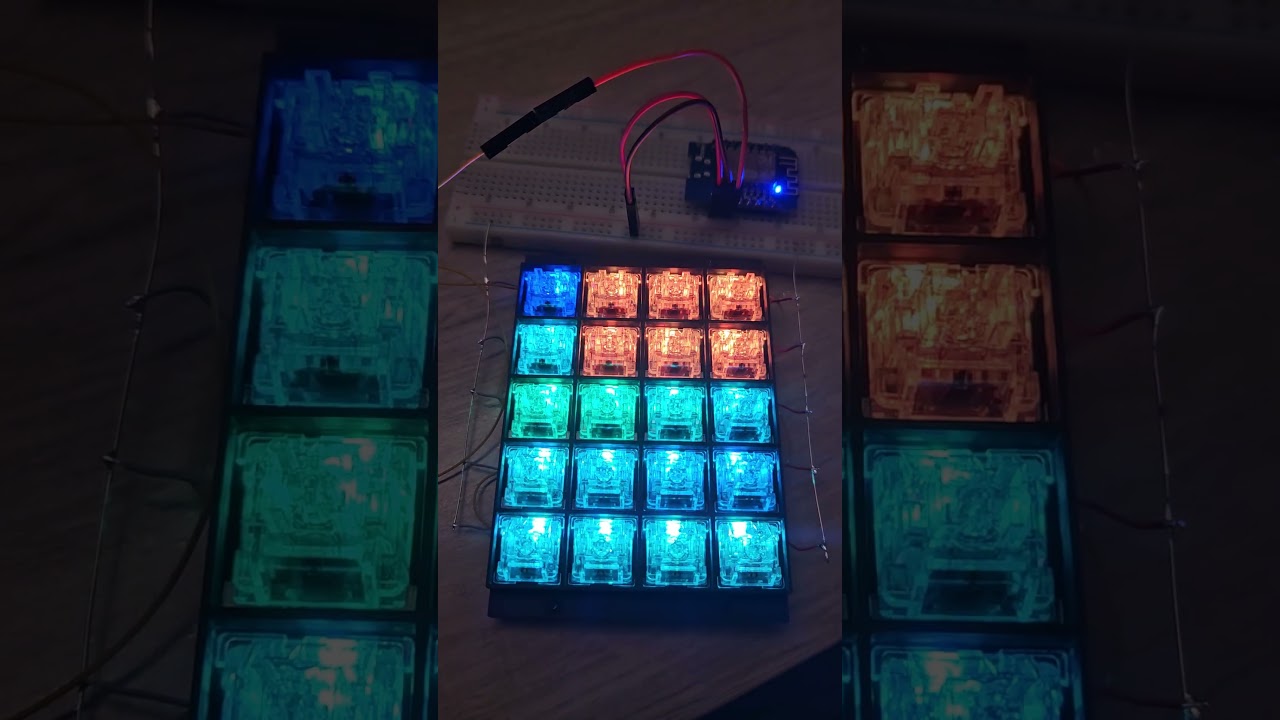
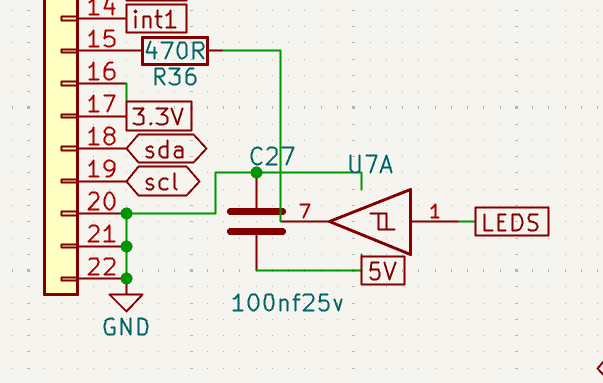
I used the V5 schematics from the repo (I have Kicad installed), but omitted the 74LVC3G17. This Schmitt Trigger is non-inverting, so it should work and is only used as a buffer. The Leds are connected to the right pin (GPIO10/WiringPi pin 12/Board pin 19). There is no cap between the Pi and the leds, only a 470 ohm resistor.
If you ever run in to the problem of flickering or non-working WS2812B LEDs with 5V supply and a 3.3V controller, you may try to add a simple diode or part of a rectifier to the 5V supply for the LEDs to reduce the WS2812B voltage to 4.3V, which is still in-specs and lowers the high-level threshold of the data signal, which is dependent on and relative to Vcc.
For example, when I use 5.1V coming directly from a 5A USB-PD source to supply for the LEDs (still in-specs), then the 3.0V high level of the Pi output will be at the margin. With the diode in the 5.1V line, it is perfectly fine.
Thanks for the advice! I experience such problems with my WLEDs occasionaly. Usually I improve it by adding another capacitor to the 5V or “cleaning the contacts”, but I suppose this might be the real cause - signal at the edge.
Can you suggest a typical type of diode when powering with a 10, 20 or even 30A source? I power several strips sometimes and usually at both ends (as often suggested) - should I add one diode at each end (like the capacitors) or is it enough with just one at the power source output?
I don’t know what your usecase is, but for longer strips I use the boards from Quindor. He has also an extensive writeup on longer and high-power strip-feeding…
For such a large amount of LEDs it might be better to use a simple data line driver with level shifter, like the SN74AHCT125N. It has to be the AHCT type of chip, this one has the required specs.
With this you can level-up four data lines or two data lines and two clock lines, for example.
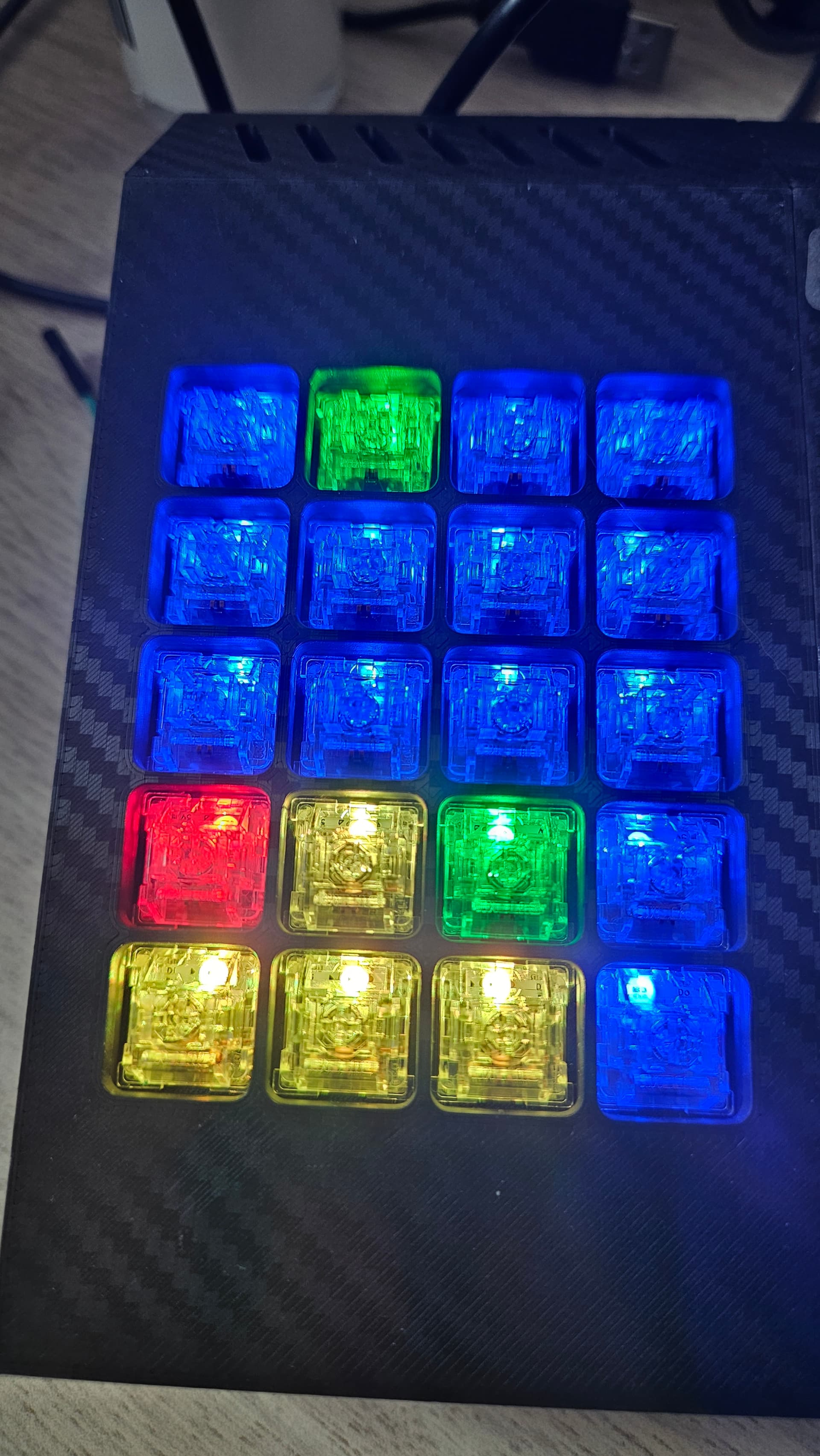
The trick with the diode works reasonably for supply currents up to several hunderd mA, like for the keypad illumination. Otherwise you might need to use one diode for each group of 10 to 20 LEDs, but the dropped voltage will simmply be converted into heat, reducing overall efficiency.
That’s definitely the safest solution. I just wonder whether my problem is not different now: I experience random flashes in the second half of my LED strips. In one case it concerns mostly single LEDs, in the other case the whole half of the strip (or more). Th first LED should already stabilize the output level enough for the whole rest, shouldn’t it?
If the cahin of LEDs is long, you will need to add additional power inputs to the strip. The thin power lines on the flex-pcbof the strip is too weak to carry current for more than 10/20 LEDs safely. Also it is important to give every LED a 0.1µF Ceramic close to the package to stabilise power.
Obviously, the problem is bad LEDs in the chain. No help by adding power. No help by trying to resolder the contacts (it seemed to react to bending the strip). I already had to cut out one of the LEDs and maybe I will have to cut out more (at the moment the other problematic ones still become stable after a few seconds of “heating-up”). That is the result of buying “cheaply” on Ali.
There seem to be capacitors on the strips. And it can carry a good deal of current. With 144 LEDs per meter, I would have to solder a parallel wire to the whole strip if I wanted to provide “additional power inputs” every 10-20 LEDs.