Ohhh yessss!!
We hope to release a MIDI 2.0 driver integrated with zynthian along the first weeks of 2025.
Stay tuned!!
The best!!
Ohhh yessss!!
We hope to release a MIDI 2.0 driver integrated with zynthian along the first weeks of 2025.
Stay tuned!!
The best!!
Hello to all Zynthianers,
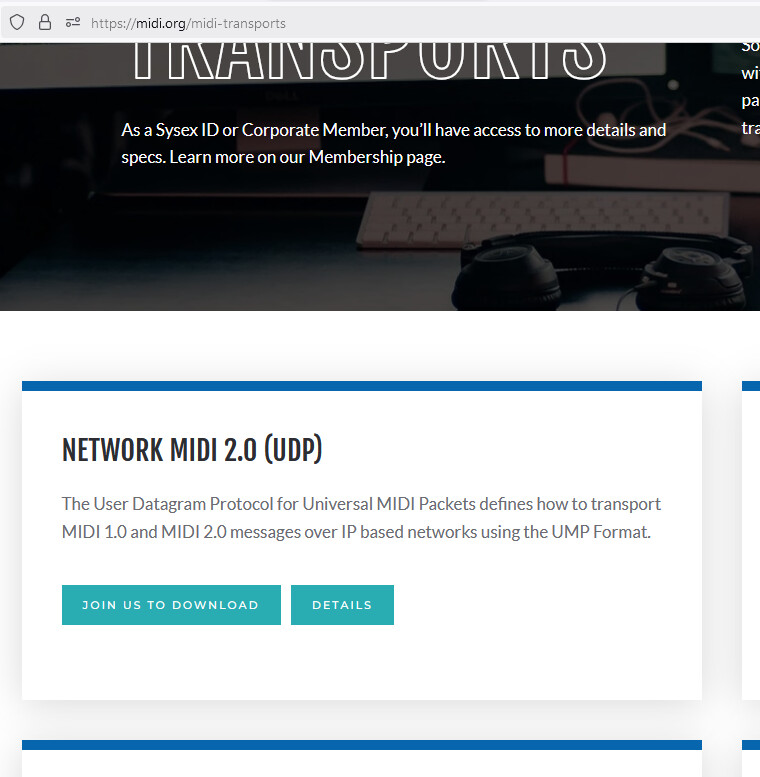
as revealed by @jofemodo, the Zynthian will be one of the very first machines on the market with Network UMP integrated in it, which then opens the world of MIDI 2.0 
MIDI 2.0 : velocities on 16 bits, controls changes on 32 bits…
The protocol specification has been published officially by the MMA :
And you can find the daemon source code for the Zynthian here :
A free Windows driver and macOS driver are on the way (question of days), they will available here : https://kiss-box.com/downloads-archive/windows-rtp-ump-driver-for-64-bit-systems/
FOR THOSE WHO WANT TO START PLAYING WITH NETWORK UMP : the V2.7 driver available of KissBox does not include the Network UMP protocol, you will need to install V4.4 (please wait until we update the website  )
)
And for those who can’t wait : I can send you the driver installers 
If any of you want to start to experiment before the driver is officially integrated in the Zynthian, I can start a dedicated thread explaining how to use the executable file available on the Release page of the Github
Benoit
Some perhaps useful MIDI 2.0 resources from the “July MIDI Notes Newsletter” of The MIDI Association:
MIDI 2.0 Developer Collaboration
Contributing to the MIDI 2.0 Developer Community
Supported by core MIDI 2.0 working group members, MIDI2.dev aims to promote the adoption of MIDI 2.0 by providing tools and libraries useful to developers.
Resources include C++ Libraries, USB helpers, testing applications, and more from leading contributors to the MIDI 2.0 specifications.
Our repositories are at https://github.com/midi2-dev
Is it still the case that midi 2.0 in Zynthian is still only provided by netUMP? I’m also curious what aspects of midi 2.0 (if any) are taken advantage of at this stage?
I’ve been loosely following midi 2.0 developments (mostly interested in Midi-CI) and last time I looked, USB Midi 2.0 /UMP hadn’t been enabled in the latest Debian/Raspberry Pi OS Kernel by default. Also the version of Alsa Utils? which I think is required to take advantage of Midi 2.0 doesn’t seem to be available on Bookworm. I don’t know if any of this will change in the next version of Debian/Raspberry Pi OS.
It’s interesting, but quite slow atm. I guess things may hot up a once Midi 2.0 in Windows works and more hardware developers get on board.
Came across some MIDI 2.0 docs via AMEI (you will have to translate the Japanese in your browser). The english PDF’s are here.
You can access the Github pages deployment via their github if you want to download all the pdf’s in one zip. The current v.0.1.16 deployment is here.
The full official Association of Musical Electronics Industry (AMEI is based in Japan) home page also has some pdf’s scattered around it associated with their MIDI Standard Committee work.
I read that the new release of Debian, Trixie, supoorts MIDI 2.0 in addition to RISC-V. I think I have spme understamding of what that means, but not much. My intention in making this post is to suggest that we consider moving to Traxie in Vangelis, but I would like it anyway so I don’t know what benefits it would really bring. I’m wondering if we had a MIDI 2.0 Engine or Plugin, and a MIDI 2.0 hardware controller would it work today or would it be somewhat limited because we’re not running Trixie in Zynthian. I do understand that we’d be talking about Raspian for Zynthian.
I asked Gemini: some really lazy prompts and then the real question, jump to the summary at the end if you don’t want to plow through the background.
midi 2.0 trixie
Trixie and MIDI 2.0
It seems there might be a connection between “Trixie” and MIDI 2.0 in the context of the Debian 13 “Trixie” operating system, which includes support for the MIDI 2.0 standard.
Here’s a breakdown:
MIDI 2.0: This is a significant advancement in the MIDI protocol, offering several key improvements over MIDI 1.0, including bidirectional communication, increased resolution for controls (32-bit), more controllers (over 32,000), better timing, and auto-configuration capabilities.
Debian 13 “Trixie”: This version of the Linux-based operating system now includes MIDI 2.0 support through the ALSA sequencer API. This means that users of Debian Trixie can utilize the enhanced features of MIDI 2.0 with compatible hardware and software.
Important Notes:
While Debian Trixie offers support, it’s crucial to remember that MIDI 2.0 adoption is still ongoing. You’ll need both a MIDI 2.0-enabled operating system like Trixie and MIDI 2.0 compatible hardware and/or software to fully utilize the new features.
MIDI 2.0 is designed to be backward compatible with MIDI 1.0. This means your older MIDI devices will still work, although you won’t experience the full benefits of MIDI 2.0 with them.
and then midi 2.0 trixie zynthian
AI Overview
Based on the provided search results, here’s a summary of the intersection of MIDI 2.0, Zynthian, and “Trixie”:
Zynthian is actively working towards MIDI 2.0 support:
Zynthian is reportedly one of the first hardware synthesizers to support MIDI 2.0 / UMP (Universal MIDI Packet).
Development includes an RTP-UMP daemon for handling MIDI 2.0 messages.
Work is underway on a software bridge for controlling Zynthian over MIDI 2.0 from various operating systems (Linux, Windows, and eventually Mac).
Zynthian has announced Network UMP (the MIDI Manufacturers Association’s method to transport UMP over Ethernet) support in January 2025.
“Trixie” refers to the Debian operating system version:
Debian 13, codenamed “Trixie”, was released on August 9, 2025.
It’s a stable release and includes support for various architectures, including 64-bit PC (amd64), 64-bit ARM (AArch64), and others.
ZynthianOS is the operating system that runs on Zynthian hardware, and it is built upon Debian.
MIDI 2.0 offers potential benefits for Zynthian:
Enhanced capabilities like increased resolution for Channel Voice Messages, improved Per-Note control, and more musical expression.
Bidirectional communication (MIDI-CI) allowing devices to negotiate capabilities and potentially streamline MIDI mapping, according to Sweetwater.
Possible improvements for working with microtuning and MIDI, according to Reddit.
Current state and considerations for MIDI 2.0 and Zynthian:
While Zynthian is working on MIDI 2.0, the broader adoption of the standard is still in progress.
There is a limited number of input devices and software supporting MIDI 2.0 natively.
Zynthian currently implements MIDI using the Raspberry Pi UART for 5-pin MIDI and standard Linux drivers for USB MIDI.
The Zynthian community has discussed using multiple MIDI-USB controllers and potential kernel limitations regarding the number of connected devices.
In essence, Zynthian is progressing towards MIDI 2.0 integration, leveraging the capabilities of Debian “Trixie” as its underlying operating system, but full utilization will depend on the wider adoption of the MIDI 2.0 standard in the music technology landscape.
and finally:
Zynthian is presently running bookworm, does zynthian need to run Trixie in order to support midi 2.0 synthesizers and or controllers?
Based on the information available, Zynthian’s MIDI 2.0 support doesn’t necessarily depend on running Trixie (Debian 13), though there might be some advantages to it down the line.
Here’s why:
Zynthian already has a form of MIDI 2.0 (UMP) support: Zynthian has had some level of support for MIDI 2.0 messages (UMP) since at least late 2022, primarily acting as a hardware synth that can receive MIDI 2.0 messages. This is achieved using Universal MIDI Packet (UMP) which allows smooth transition and compatibility with MIDI 1.0 devices.
MIDI 2.0 is designed for backward compatibility: Devices that support MIDI 2.0 can still communicate with MIDI 1.0 devices. So, your existing setup should continue to function.
Developers are working on improving Zynthian’s MIDI 2.0 integration: There has been ongoing development, including an RTP-UMP daemon for Zynthian and a software bridge to control it over the MIDI 2.0 protocol, aiming to be a very early supporter of MIDI 2.0 in hardware synthesis.
Trixie might offer some benefits in the future: Debian 13 “Trixie” brings updates to various packages, including Qt and KDE Frameworks. While not directly about MIDI 2.0 support, these updates could potentially provide a more modern and potentially more stable base for future development and improved performance, but an upgrade might not resolve all issues.
In summary
While Zynthian has some existing MIDI 2.0 capabilities, upgrading to Trixie might not be strictly necessary to utilize MIDI 2.0 synthesizers and controllers with it in the present. It’s more likely that the ongoing software development efforts and improvements to the MIDI stack will be key to full and robust MIDI 2.0 functionality. Staying updated on the Zynthian community forum and development channels is likely the best way to stay informed about MIDI 2.0 integration progress and whether a migration to Trixie becomes essential for specific features.
And then: Can you tell me more about what features it might be essential for? in the context of the previous question: Zynthian is presently running bookworm, does zynthian need to run Trixie in order to support midi 2.0 synthesizers and or controllers?
Features of MIDI 2.0 relevant to Zynthian
The user is asking about the need for Zynthian to run Debian Trixie to support MIDI 2.0 synthesizers and controllers, as it’s currently running Bookworm. It’s also important to understand the features of MIDI 2.0 that make this relevant.
Here’s a breakdown of MIDI 2.0 features that might be essential for Zynthian:
1. Universal MIDI packet (UMP)
Key improvement: Replaces the byte stream of MIDI 1.0 with a 32-bit packet format.
Benefit for Zynthian: Potentially allows for more efficient and lower-latency communication between the Zynthian and MIDI 2.0 devices.
Relevance to Bookworm/Trixie: Linux kernel 6.5 and later includes support for UMP. Debian Bookworm ships with an older kernel (e.g., 6.1 or earlier) while Trixie has a newer kernel, according to Debian. Therefore, upgrading to Trixie could be necessary for Zynthian to fully leverage UMP capabilities.
2. Higher resolution and more controls
Key improvement: MIDI 2.0 offers higher resolution for expressive control and expands the number of available controllers.
Benefit for Zynthian: This translates into more precise and nuanced control over synthesizers and effects within the Zynthian ecosystem, offering a richer musical experience.
Relevance to Bookworm/Trixie: While some MIDI 2.0 features might be accessible on older systems through workarounds, deeper integration and full utilization of high-resolution control and expanded functionality might necessitate a newer Linux environment like Trixie, which likely includes updated ALSA libraries and other software components that can take advantage of these features.
3. Per-note expression and articulation
Key improvement: MIDI 2.0 introduces features like per-note pitch bend and articulation, allowing for more realistic and expressive performances.
Benefit for Zynthian: Could enhance the playability and expressiveness of virtual instruments running on Zynthian, especially when paired with a compatible MIDI 2.0 controller.
Relevance to Bookworm/Trixie: Similar to the previous point, full support for these advanced expressive capabilities may require the updated Linux kernel and software stack offered by Trixie.
4. MIDI-CI (capability inquiry)
Key improvement: Enables devices to discover each other, exchange information about their capabilities, and configure their behavior dynamically.
Benefit for Zynthian: Can streamline the setup and integration of new MIDI 2.0 devices, enabling automatic mapping and configuration, and eliminating the need for manual setup and troubleshooting.
Relevance to Bookworm/Trixie: While MIDI-CI relies on SysEx messages, which are part of MIDI 1.0, user-space applications need to implement the MIDI-CI features themselves. The availability of necessary libraries and tools for this might be more robust in Trixie.
5. Backward compatibility
Key feature: MIDI 2.0 maintains compatibility with MIDI 1.0, enabling devices using both protocols to communicate with each other.
Benefit for Zynthian: Users can still connect their existing MIDI 1.0 gear and seamlessly integrate them into their MIDI 2.0 workflow.
Relevance to Bookworm/Trixie: This feature is primarily handled at the kernel level and shouldn’t be significantly impacted by the Linux distribution version.
In summary, running Zynthian on Trixie, with its newer kernel and potentially updated software stack, could be beneficial for fully harnessing the advantages of MIDI 2.0, especially regarding UMP, higher resolution control, and enhanced per-note expression. However, some MIDI 2.0 features, like basic MIDI-CI communication, might still function adequately on Bookworm through existing MIDI 1.0 channels. The decision to upgrade depends on the user’s specific needs and desired level of MIDI 2.0 integration.
Excellent summary, thank you. You may skip the soup entrée
I bet Stradivarius never had these issues.